How Philosophy Fits In With Biology.
We need philosophers of biology.
In modern molecular biology, we seldom come across pure philosophers of biology. However, there are problems that need addressing in the philosophy of biology. Back in the mid 20th century, Hull was experiencing a different problem; hypocritical philosophers discussing biology and failing to grasp its complexity, its scientific method, and being blind to their own prejudices. David Lee Hull raised the bar on what the field of the philosophy of biology is and can be.
In conclusion, there are many things that philosophy of biology might be. A philosopher might uncover, explicate, and possibly solve problems in biological theory and methodology. He might even go on to communicate these results to other philosophers, to scientists, and especially to biologists. He might show what consequences biological phenomena and theories have for other sciences and for philosophy or to show what consequences other sciences and even philosophy have for biology. These are some of the things which philosophers of biology might do. With rare exception, they have not. What philosophy of biology is not? It must be admitted that thus far it is not very relevant to biology, nor biology to it.
Hull was the driving force behind the philosophy of biology becoming a subject in its own right. One important concept to be aware of is that in 1983 he published a book that reviewed science through the 19th century. He describes that the English-speaking scientific world became self-aware to what it means to have a convincing piece of evidence in his book, “Darwin and His Critics: The Reception of Darwin’s Theory of Evolution by the Scientific Community”. He then goes on to describe how the scientific method of biology is indeed undergoing an evolution of its own. So keep that in mind. His ideas consist of primarily (i) what is good evidence and (ii) science changes in an evolutionary way.
Priests of Biology
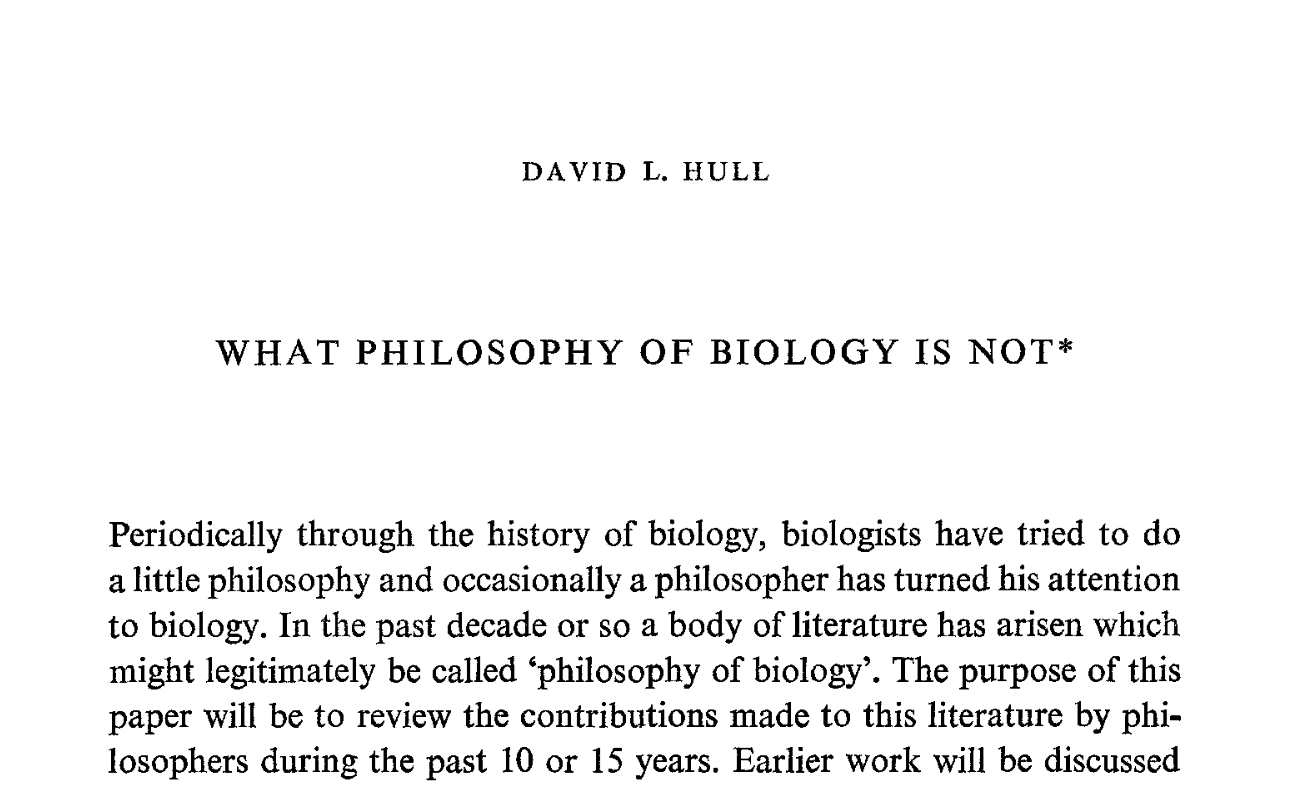
The 1969 essay “What Philosophy of Biology is not” is in my view a related precursor to his later work. He, like many, attacks critics of Darwin’s natural selection. Peculiarly his criticisms are directed at misinformed philosophers. He argues their criticisms of natural selection are tautological misunderstandings of a physical system. Broadly the essay concludes that the philosophy of biology is not merely discussing the soul and nature of self in the context of poorly understood evolution.
What kind of proof is necessary before a scientific theory can be accepted?
One point he makes requires some understanding of a Philosopher, Andrew van Melsen, and a Jesuit Priest, Teilhard de Chardin. Van Melsen proposed the idea that natural sciences deal with only outside reality and fail to touch the inside manifestation of the self. He believes in souls and had a hierarchy between plants, animals, and higher beings. However, the same van Melsen also claims that Darwin’s theory of Evolution is below par as a scientific theory as it lacks foundation. Hull agrees that Darwin’s foundations aren’t convincing enough by themselves, but he quickly strips the notion that van Melsen’s own ideas are in anyway scientific since they cannot be interrogated. I can see why Hull went on to be quoted as saying:
Hypocrisy is the lubricant of society.
His sympathy for the views of van Melsen is further tamed as he mockingly states:
But he also discusses the evolutionary views of G. G. Simpson and Teilhard de Chardin as if they were on an equal footing scientifically. If the synthetic theory of evolution is based on belief, what must Teilhard’s theory be based on? What kind of proof is necessary before a scientific theory can be accepted? Is there no difference between the evidence adduced in support of modern evolutionary theory and Teilhard’s views?
Overall, whilst this paper solidified the place of the philosophy of biology as a school of thought and in many ways was the foundation for much of Hulls’ work that would follow, the essay “What the Philosophy of Biology is not” is a 28 page dense philosophical exploration of an entire field covering the life work of many philosophers; it’s not an easy read and has few conclusions the brief reader can take away confidently. But the frustration of Hull and his whimsical rebuttals to the misunderstandings of his peers and colleagues results in some gems.
D. L. Hull, What philosophy of biology is not. Synthese. 20, 157–184 (1969).