Science Needs Room For Creativity.
I’m Just Looking For Some Answers
Nicola Davis of the Guardian opens her interview of Robbert Dijkraaf with an antiquated recording from a Johns Hopkins review. The voice we hear describes a thought-provoking anecdote.
I was showing a friend of mine through one of the laboratories at Johns Hopkins University, where he was talking with a research scientist.
He said “This is all very wonderful. But, what does it mean? What value has it? How can you use it?”
The scientist said “I don’t know. I’m just looking for some answers.”
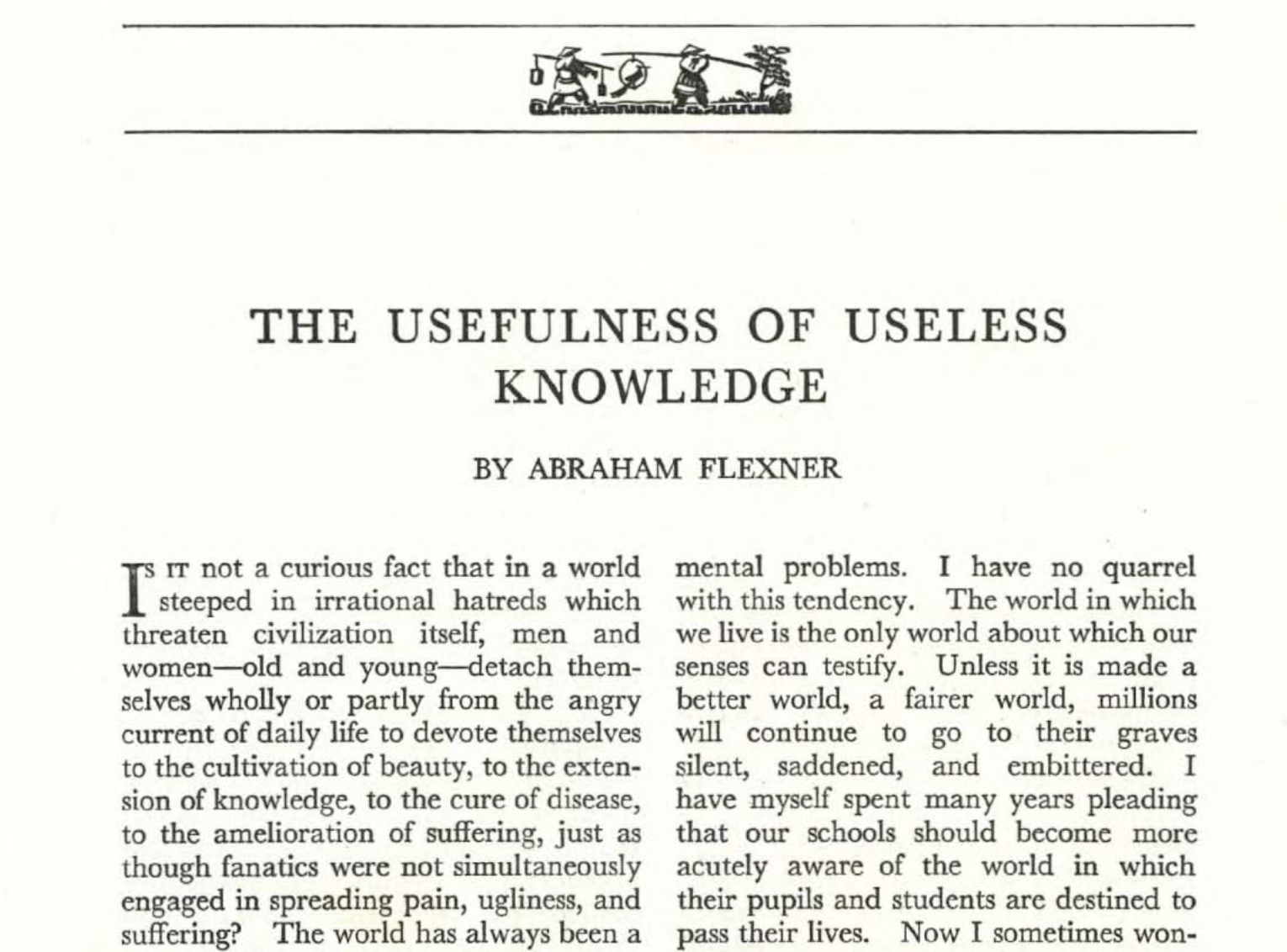
This exchange sets the stage perfectly to understand Abraham Flexner’s passion for a spiritual & intellectual approach to curiosity-driven discovery. In this essay, Flexner argues for rejecting the institutional constraints placed on academics. The essay is considered a classic and was republished by Flexner in 1955 with some minor alterations and again, posthumously, in 2017 along with a companion essay by Robbert Dijkgraaf.
Reform from pragmatism to curiosty
Abraham Flexner was responsible for large reform in both science and medicine in North America throughout his lifetime. Particularly, “The Usefulness of Useless Knowledge” published in 1939 changed the behaviour of many Universities. It was common for universities to practise a utilitarian teaching method. A typical case of such teaching was the University of Columbia which offered courses like poultry raising and beekeeping indicative of the short-term incremental focus of academic institutes. Flexner argued that universities needed to cultivate their academics curiosity, and not constrain it to the most immediate practical purpose. Given that “translational research focus” is making a resurgence throughout the life sciences, we need to consider this essay again.
We gain some insight into Flexner’s critical nature in this paper when he talks about Marconi’s historic Nobel prize-winning feat of the invention of the wireless radio as merely the last stage of the work by Maxwell and Hertz, discrediting Marconi of any bona fide discovery.
The inventor in the legal sense was, of course, Marconi, but what did Marconi invent? Merely the last technical detail, mainly the now obsolete receiving device called coherer, almost universally discarded."
Through this point and similar mentions of great progress, he emphasises that the real discoveries behind the key revolutionary inventions such as the radio were “blue sky” research initiatives. In Flexner’s day, and indeed our own, such abstracted research proposals performed by Hertz and Maxwell would, if not struggle to get funding, be strongly discouraged. Their retrospectively important studies were only made possible because scientists were allowed to explore what was curious to them.
Do we need the same push for creativity now?
The essay reintroduced a platonic concept seldom seen in the modern world. It introduces scientists, artists, and poets as being aligned in their wonderful attempt to push the boundaries of curiosity and knowledge. He presents these as separate to engineers and lawyers for which a “usefulness” to their work is the ultimate point.
Flexner’s essay is a reminder that, if left unchecked, the world will see science as an “input-output” tool that responds proportionally to the input applied by administrators. Indeed, science is much more peculiar and behaves more like the arts. If we want great scientific progress, we must make sure talented, ambitious, and curious people are given unbridled space to explore the world around them and trust that as a collective that they make great discoveries.
Much more am I pleading for the abolition of the word “use,” and for the freeing of the human spirit.
Flexner, A. (1939). The Usefulness of Useless Knowledge. Harpers, (179), 544–552.
Retrieved from https://library.ias.edu/files/UsefulnessHarpers.pdf